



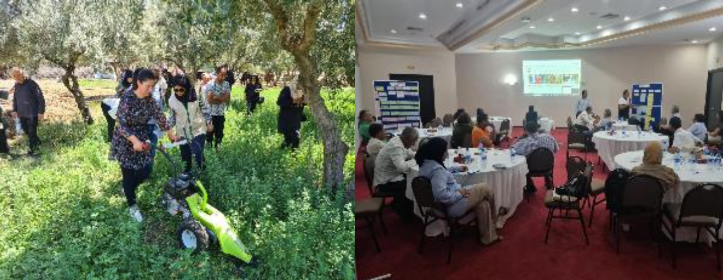
The International Center for Agricultural Research in the Dry Areas ICARDA and its national partners in Tunisia engaged in a comprehensive dialogue with private sector entities specializing in manufacturing and trade of small mechanization, along with farmers’ organizations and representatives, to explore potential pathways and identify priority actions necessary to formulate national strategic plans. A high-level national workshop titled “Petite Mécanisation Agricole – Vision 2030 en Tunisie” was organized in Hammamet, Tunisia, on June 25th. The workshop brought together over 30 participants from the public and private sectors, farmers’ organizations, and research institutions. The objective of the workshop was twofold: first, to identify pathways and concrete priority actions, including Public Private and People Partnerships (PPPPs), needed for the development of the sector of scale-appropriate mechanization in Tunisia; and second, to support ICARDA and its National Agricultural Research System (NARES) in Tunisia in identifying priority investments of the CGIAR Multifunctional Landscapes Science Program (MFL SP) to further support such an important national orientation.
A notable outcome of the workshop was the collective commitment to developing a PPP transition model for small-scale mechanization. A fourth working group discussion was dedicated to this purpose. In fact, the private sector has expressed its strong willingness to collaborate with public authorities. This collaboration would benefit from the public authorities’ extensive data sets and connections with farmers. This would enable the private sector to enhance its comprehension of farmers’ needs and demands, facilitating the conversion of this data into market opportunities. They were also calling for joint collaboration with public agencies, particularly Tunisia’s network of agricultural extension services, technical centers, and universities. These entities should be used as platforms to gather and share this information and as spaces for piloting these innovations. These centers and universities usually have pedagogical farms that could serve as a living lab for co-designing, piloting, and testing demand-oriented solutions with farmers and other local actors.
